
We provide concrete removal in Dale City, VA and across Prince William County for homeowners and property owners: driveways, patios, slabs, sidewalks, and steps. The old concrete gets broken out and hauled off, and the ground is backfilled and graded for a new pour or for grass.
This page answers one question. Does this concrete need to come out or can it be patched, and what does removal involve if it goes?
Start with the weight, because weight explains the price. A plain 20 by 20 foot driveway, poured four inches thick, weighs close to 10 tons. That is heavier than a loaded garbage truck parked in front of your house.
Weight is the reason concrete removal in Dale City, VA gets priced by tonnage and truck trips rather than by the hour.
Which concrete removal jobs in Dale City, VA do we handle?
Concrete removal in Dale City, VA covers flatwork, footings, and structural slabs on residential and small commercial property. These are the jobs that come up most often across Prince William County:
- Driveways, aprons, and parking pads
- Patios, walkways, and garden paths
- Sidewalks and curbing
- Garage, shed, and porch slabs
- Front steps, stoops, and stair landings
- Old footings, foundation walls, and pier blocks
- Pool decking and coping
- Small retaining walls and block sections
- Asphalt driveways, which break and haul the same way
Every one of those jobs includes saw cutting for clean seams, breaking, separating steel from the rubble, loading, hauling, disposal, and backfill, so you are not left with a trench where the slab used to be.
How do you know a slab needs to come out instead of get patched?
A slab needs to come out once the base underneath it is gone, and it can be patched when the base is still solid and only the surface has suffered. That one test decides almost every concrete removal call in Dale City.
Patching a slab that has lost its support buys a couple of seasons at best, because the new material sits on the same failing ground that cracked the old material.
Replace rather than repair when you see:
- Sections that have settled or heaved more than an inch out of plane
- Cracks wide enough to catch a shoe or a stroller wheel
- Spalling and flaking that keeps spreading each spring
- Water running toward the house or into the garage instead of away
- Tree roots lifting a walkway or driveway edge
- A slab that is simply in the wrong place for what you want to build
Patch or resurface instead when:
- The cracks are hairline, stable, and have not moved in a year or two
- The slab is level across its whole surface and still drains correctly
- Only a small corner or edge has broken away
Older Prince William County properties tend to hit the replace column all at once. Many of the driveways in the original Dale City sections are on their first or second pour after fifty-plus years.
Why does concrete fail in Northern Virginia?
Concrete in Northern Virginia usually fails from underneath rather than from the top, and the local climate and soil do most of the damage. These are the causes behind nearly every cracked driveway and sunken patio in Prince William County.
- Base failure: the gravel or compacted soil under the slab washes out or settles, the concrete loses its support, and it cracks under normal vehicle weight
- Water intrusion: water finds a crack, carries fines out of the base with it, and enlarges the void a little more with every storm
- Freeze and thaw: trapped water freezes in winter, expands, and pops the surface apart, which is what spalling and flaking actually are
- Road salt: salt tracked up the driveway all winter accelerates that surface breakdown and attacks the rebar underneath
- Clay soil movement: the clay soils common in this county swell when wet and shrink when dry, lifting one part of a slab while another drops
- Tree roots: roots follow moisture under the slab and lift the edge that they reach first
Cause matters because it decides the fix. A surface problem can be resurfaced. A base problem comes back within a season or two unless the concrete comes out and the ground underneath gets rebuilt properly.
Do you need a permit for concrete removal in Prince William County?
Concrete removal on its own is rarely permitted work in Prince William County, and straight replacement flatwork usually needs no building permit at all. Two things change that answer, and both come up more often than homeowners expect.
First, work in the public right of way. If your driveway apron ties into a county or state road, that connection is controlled and needs an approved entrance or right of way permit. Second, land disturbance.
Prince William County follows the Chesapeake Bay Preservation Act, so land disturbance of 2,500 square feet or more triggers erosion and sediment control requirements rather than the 10,000 square foot threshold used elsewhere in Virginia.
A big patio plus a driveway can cross that line faster than you would think, so measure before you assume the job is exempt.
Prince William County Development Services handles those permits, and Virginia DEQ sets the stormwater program the county administers.
When breaking out concrete is part of taking a structure down, the demolition permit and asbestos rules apply to the whole job. Virginia requires a survey before older buildings come down, and the federal NESHAP rule governs how any regulated material is handled.
What does concrete removal cost in this part of Northern Virginia?
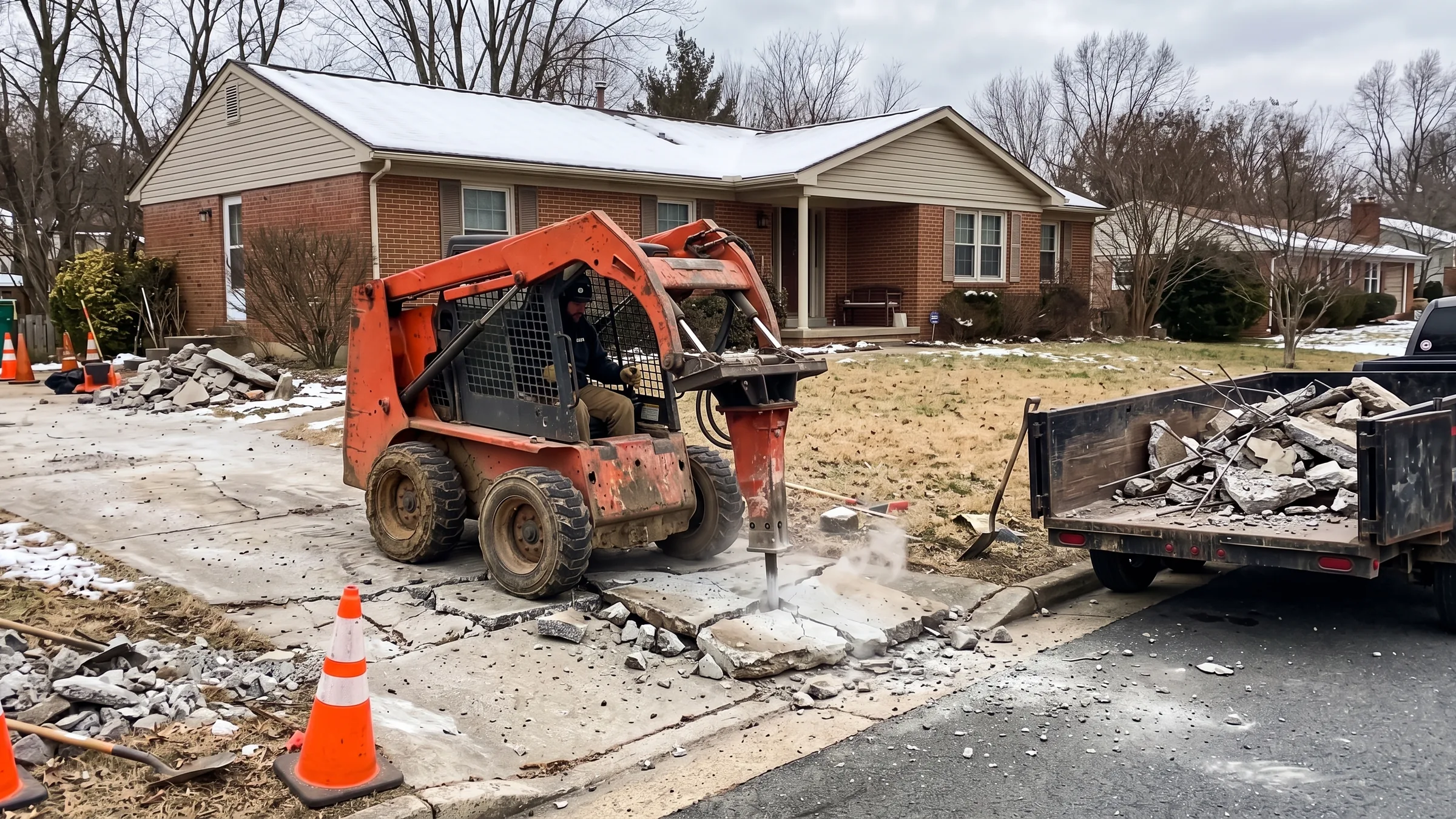
Concrete removal in this part of Northern Virginia is priced on square footage, thickness, reinforcement, and access. A four-inch residential driveway breaks up quickly, while a six-inch reinforced commercial pad takes real machine time and produces far more tonnage.
Typical regional ranges:
- Unreinforced flatwork: roughly $2 to $4 per square foot removed and hauled
- Reinforced or thicker slabs: roughly $4 to $8 per square foot
- Two-car driveway, start to finish: commonly $1,500 to $3,500
- Small patio or walkway: commonly $600 to $1,500, including a minimum trip charge
Access is the wildcard that moves those numbers most, because a backyard patio that a truck cannot reach means every piece gets carried or wheeled out by hand.
Homes on the sloped lots near the Occoquan and along the ridges through the Lake Ridge neighborhoods run into that constantly, where a walkout basement patio sits fifteen feet below the only place a dump trailer can park.
Distance to disposal matters too. Clean concrete goes to a regional aggregate recycler to be crushed into reusable base stone, while mixed material heads to the county complex at Independent Hill or a private construction and demolition facility.
Recycling the clean material is usually the cheaper of the two, which is one of the few places this trade saves you money and does the right thing at the same time. To see how these numbers compare with other demolition work, check the Prince William County demolition cost guide.
What happens on concrete removal day?
On removal day the crew marks the cut line and confirms utility locations before anything starts, since gas and water services often run under a driveway or an apron. Public utility marking is free and always worth ordering before a machine touches the ground.
A saw cut gets made wherever concrete stays. Then a hydraulic breaker or a hoe pack works the slab into liftable pieces, steel gets pulled and set aside for scrap, and the loader feeds a trailer parked as close as the site allows.
Once the material is gone, the void gets backfilled and compacted, the edges are cleaned up, and the whole area is raked out. If a new pour is coming, the site is left at proper subgrade so your concrete contractor can form and pour without a re-dig.
Projects that often come with concrete work
Breaking out concrete rarely travels alone. Pool decking usually comes out as part of filling in an unused in-ground pool, and slabs, footings, and foundation walls all get removed as part of a whole-house teardown.
We also handle driveway and pad breakout for owners across the Woodbridge area, where Route 1 corridor properties often have decades of patched paving stacked on top of each other.
Concrete removal questions we get most often
How long does it take to remove a driveway?
A standard two-car driveway comes out in a single day. Breaking, loading, hauling, and raking the area out all happen the same day on most Dale City properties. Thicker or heavily reinforced pours can stretch into a second day. If a new driveway is going back in, schedule the removal a day or two ahead of your concrete contractor so the open subgrade does not sit through a rainstorm.
Will heavy equipment tear up my lawn?
Some marking where trucks and tracks travel is normal on any slab removal. Crews run plywood or ground mats over soft ground and take the shortest route from the concrete to the truck. Ruts get raked and topsoiled before anyone leaves, and seed or sod can be added to the scope if you want the lawn finished rather than just repaired. Ask for that line in writing if the yard matters to you.
Do you take the concrete to the landfill?
Clean concrete gets recycled rather than buried. It goes to a regional aggregate recycler, gets crushed, and comes back as base stone for another project, which is usually cheaper per ton than landfill disposal. Concrete mixed with soil, roots, or asphalt often has to go to a construction and demolition facility instead at a higher rate, so keeping the material clean during breakout directly lowers your bill.
Can you remove just part of a slab and leave the rest?
Yes, and partial removal is common when only one bay of a driveway has failed or a patio is being made smaller. A saw cut gives a clean, straight edge so the section that stays holds a solid line for the new pour to meet. Say up front where you want the seam, because cutting first changes how the breakout is staged and it is priced as its own line item.
What happens to the hole after the concrete is gone?
The void gets backfilled with clean fill or gravel and graded flat so water drains away from the house. If a new pour is coming, the area is left at proper subgrade so your concrete contractor can form and pour without a re-dig. If it is going back to lawn, topsoil can be brought in and seeded. Decide which of those three you want before the job is quoted, because each one prices differently.
Ready to get that slab out of the way?
Breaking out old concrete is usually the easiest project on your list to get moving. Send the rough dimensions, tell us what the truck access looks like, and you will get a real price range the same day.
Call now, or fill in the short form below and you will get a call back with a number and a date.