
We provide land clearing in Prince William County VA for property owners and builders who need a lot made usable: brush, trees, stumps, old structures, and debris removed, then the ground graded and the water controlled. The outcome is a build-ready lot.
This page answers one question. What does it take to get your parcel cleared and ready to build on in this county?
Northern Virginia is the largest data center market on the planet, and Prince William County has approved rezonings covering thousands of acres to keep feeding it. Every warehouse pad, substation, access road, and new house behind that growth starts the same way.
The equipment and the rules are the same whether you are opening 40 acres for a site plan or a half acre behind the house for a garage and a driveway.
What does land clearing include?
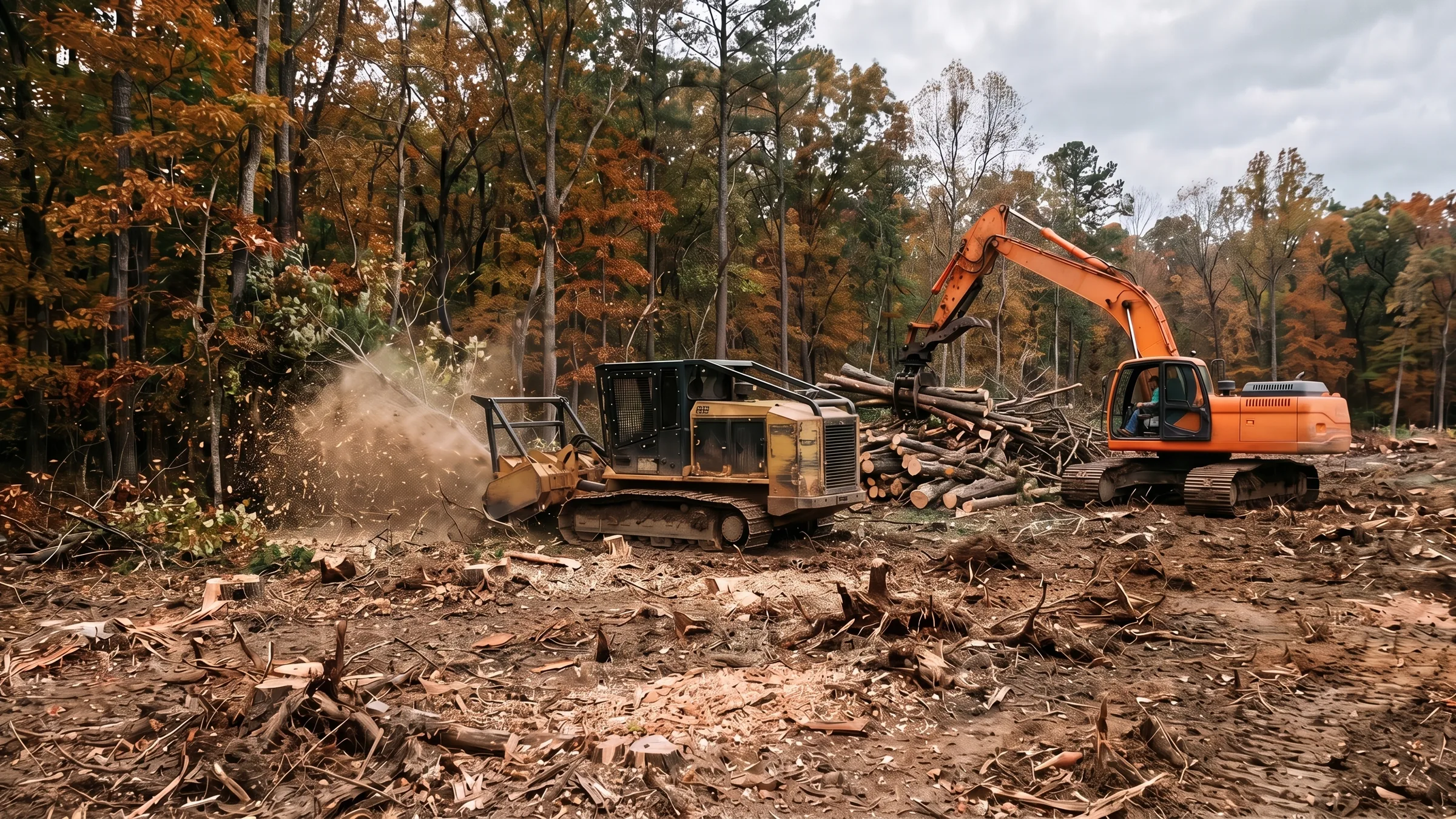
Land clearing in Prince William County VA covers everything between a wooded or overgrown parcel and a graded lot a builder can stake. A full scope normally includes:
- Brush, undergrowth, vines, and briar removal
- Tree felling, limbing, and removal or mulching
- Stump grinding or full stump grubbing with backfill
- Overgrown fence line and property line clearing
- Old sheds, foundations, wells, and debris piles removed from the lot
- Root mat and topsoil stripping where a building pad is going
- Rough grading, drainage shaping, and access road cutting
- Silt fence, inlet protection, and other erosion controls
- Haul-off, chipping, or on-site mulching of the material
Your contract should say clearly which of those items you are buying. A lot that has been mulched looks clear but is not ready for a foundation, and that gap is where most disputes on clearing jobs start.
Why do property owners need land clearing around here?
Property owners in Prince William County clear land because something specific is going in its place, and the intended use decides how thorough the clearing has to be. The reasons that come up most often:
- Building a new home, an addition, a garage, or a pole barn
- Preparing a commercial or industrial pad ahead of a site plan
- Opening room for a septic system, a drainfield, or a well
- Cutting a driveway or an equipment access road to a back lot
- Turning woods into pasture, paddock, or usable yard
- Storm cleanup after a line of trees comes down
- Pushing the tree line back from the house for light and fire safety
- Making an overgrown parcel presentable before it goes on the market
Around the built-out neighborhoods of Dale City the work is usually small and surgical: a quarter acre of overgrown rear yard, a fence line reclaimed, or a lot cleaned up between a teardown and a rebuild.
Head west and south toward Manassas and the rural crescent and the parcels get bigger, the timber gets heavier, and the equipment changes with it.
Should the material be mulched in place or hauled off?
Mulch the material in place when the ground is going back to yard, pasture, or woods edge, and haul it off when a foundation, slab, driveway, or drainfield is going on top. That single decision moves the price of a land clearing job more than anything else on the estimate.
Mulching in place works when:
- The growth is light brush and small trees rather than heavy timber
- Nothing structural is being built on that ground
- You want erosion cover on a slope while new growth establishes
- Budget matters more than a perfectly clean finished surface
Haul-off or chipping is the right call when:
- A building pad, driveway, or septic field is going in, since organic material under a structure rots and settles
- The site has old buildings, tires, or dumped debris mixed into the brush
- An inspector or an engineer needs to see clean, stripped subgrade
- You want the lot to look finished for a sale or a showing
Stumps and root mat left in the ground rot out over the years and leave soft spots, so anything that will carry a house, a slab, a driveway, or a drainfield needs the stumps grubbed out and the holes backfilled and compacted.
What goes wrong when a lot is cleared the wrong way?
A badly cleared lot creates problems that surface months or years later, long after the machines are gone. These are the failures that cost Prince William County owners the most money to fix.
- Soft spots and settlement: stumps and buried root mat decay, the ground above them drops, and a slab, driveway, or lawn sinks in patches
- Erosion: bare soil with no silt fence, seed, or matting washes downhill during the first hard rain, which costs topsoil and can bring a county violation
- Water intrusion next door: grading that pushes runoff toward a neighbor or a foundation turns a clearing job into a drainage dispute
- Freeze and thaw damage: exposed, uncompacted ground heaves through the winter and leaves an uneven surface by spring
- Soil compaction: tracking heavy equipment over the same wet ground repeatedly compacts it so hard that nothing grows there afterward
- Buffer violations: clearing into a protected stream buffer or over a property line brings a stop work order and a restoration requirement
Every one of those is avoidable with marked limits, erosion controls installed first, and the right choice between grinding and grubbing the stumps.
What permits does land clearing require in Prince William County?
Land clearing in Prince William County is one of the most regulated things you can do to a property, which surprises owners who expect clearing to be simple. Two thresholds matter more than the rest.
Prince William County is a Chesapeake Bay Preservation Act locality, so disturbing 2,500 square feet or more of land triggers erosion and sediment control requirements.
Resource Protection Area buffers of 100 feet along perennial streams and wetlands restrict clearing in those zones entirely. That RPA line runs through far more properties in the Occoquan and Neabsco watersheds than owners expect.
Land disturbance permits, site plan review, and tree conservation requirements all run through Prince William County Development Services, while the state stormwater and water quality programs behind them come from Virginia DEQ.
Wetlands add another layer, since filling or grading a wetland can require state and federal review before a machine ever shows up on the parcel.
If there are structures on the lot, demolition rules apply on top of the clearing rules. That means a demolition permit, confirmed utility disconnects at the main, and an asbestos inspection where Virginia requires one before an older building comes down.
The federal NESHAP rule governs how any regulated material is removed and disposed of. Old farm buildings and pre-1980s outbuildings are the prime candidates for a positive test.
What does land clearing cost in this region?
Land clearing cost in this region is driven by how heavy the growth is, what happens to the material, and whether the stumps come out. Those three answers can swing the price of the same acre by a factor of five.
- Light brush and small trees, mulched in place: roughly $1,500 to $4,000 per acre
- Moderately wooded, chipped or hauled: roughly $4,000 to $8,000 per acre
- Heavy timber with grubbing and full haul-off: roughly $8,000 to $15,000 per acre and up
- Small residential lot clearing for a pad or driveway: commonly $3,000 to $8,000 total
- Erosion controls, permits, and haul distance: added on top, and never trivial
Mulching in place is almost always cheaper than hauling material off, because trucking is priced by the load and by the mile, and the county complex at Independent Hill or a private facility charges by the ton once you get there.
Clean wood, brush, and stumps also go to different places than construction debris, so a site with old buildings mixed into the brush costs more to sort than one with only trees.
Terrain adds its own premium. Slopes above the Occoquan and around the Lake Ridge ridgelines make equipment selection and erosion control harder, and steep ground usually needs more silt fence, more matting, and slower work.
What happens on a land clearing job once the crew mobilizes?
A land clearing job starts with marking limits, not with cutting. Survey pins, RPA and buffer lines, tree save areas, and anything staying all get located and flagged before a machine moves onto the parcel.
Then erosion controls go in, because on any permitted job in Prince William County the silt fence is installed before the first tree drops. Clearing works from the access point inward so material can be processed and moved without driving over finished ground.
Trees come down, get limbed and processed, and stumps are pulled or ground based on what the finished use requires. That is the point where the mulch-or-haul decision you made during the estimate turns into equipment on the ground.
The last phase is dirt work: root mat and debris removed, holes backfilled and compacted, the site shaped so water runs where it should, and seeding or matting on anything left bare. A properly closed-out job leaves a lot that a builder can stake the next morning.
What often gets scheduled alongside clearing
Lots with an existing house usually need the structure and foundation taken out before clearing starts, and old driveways, pads, and farm slabs need concrete broken out and hauled so the ground can be graded clean.
Commercial parcels typically pair clearing with building teardown and site demolition. We work throughout the county, including the Dumfries and Quantico corridor where older parcels are changing hands quickly.
Clearing stops at ground level. Everything below it, meaning foundation holes, utility trenches, stormwater basins, and the finish grading a builder works to, is separate work that an Excavation Contractor picks up once the lot is open and the debris is gone. Knowing where the clearing scope ends and that one begins is what keeps two crews from pricing the same dirt twice.
Land clearing questions property owners ask
How much land can you clear in a day?
With mulching equipment on light brush and small trees, an acre a day is realistic in Prince William County. Heavy timber with stump grubbing and full haul-off runs much slower, often two to four days per acre depending on tree size and how far the trucks have to travel to disposal. Ask for a daily production estimate in the quote so you can sanity check the total against the price.
Do the stumps have to come out?
Only if something is going on top of that ground. Stumps left in place rot over the years and leave soft spots, so any area that will carry a house, a driveway, a slab, or a drainfield needs them grubbed out and the holes backfilled and compacted. Areas going back to pasture, woods edge, or open yard can usually keep the stumps ground flush, which costs much less.
What happens to the trees and brush?
You have three options on a clearing job, and the price follows the choice. Mulching grinds material in place and leaves it as ground cover, chipping loads it out as clean wood, and haul-off trucks whole material away by the load. Mulching is the cheapest and haul-off is the most expensive. Merchantable timber on a heavily wooded parcel can sometimes offset part of the cost.
Can you clear right up to my property line?
Up to the line you can prove, which is not the same as the line you believe. Survey pins get located first, because clearing over a boundary or into a protected stream buffer is expensive to correct and can bring a stop work order from Prince William County. When pins are missing, a surveyor comes before the machines. That survey costs a fraction of what a boundary dispute costs.
Is winter a bad time to clear land?
Winter is often the best time to clear land in Northern Virginia. Frozen or firm ground carries equipment with far less rutting, leaves are down so the site and its boundaries are visible, and there is less disruption to nesting and growth. Wet spring ground is usually the hardest condition to work in and the most likely to add cost for matting and repair.
Find out what your lot takes
Clearing is the first line item on almost every build in this county. Give us the address, the rough acreage, and what you plan to build, and you will get a clearing plan and a real price range, including the permit steps your parcel will need.
Call now, or send the details through the form below and you will get a response with next steps.