
We provide residential demolition in Dale City, VA and across Prince William County: house teardowns, failed additions, fire-damaged structures, and old outbuildings. Homeowners and property owners hire this work to get a permitted, cleared, graded lot they can rebuild on or sell.
This page answers the question most owners start with. Should this structure come down, and what does taking it down actually involve?
Below you will find the scope of the job, why older houses reach this point, how permits and asbestos inspections work in this county, what pushes the price up or down, and what your property looks like when the trucks pull out.
What does residential demolition include?
Residential demolition in Dale City covers the complete removal of a house and everything under it, not just knocking the walls over. The job opens with a site walk to check driveway access, utility locations, property pins, and anything close enough to need protecting.
That protection list usually includes fences, mature trees, and the neighbor's driveway apron. A full-service house teardown in Prince William County normally covers:
- Utility disconnect coordination and capping at the main
- Permit application, plus scheduling the required inspections
- An asbestos survey and any abatement the survey calls for
- Salvage or separation of metal, brick, and recyclable material
- Mechanical teardown of the structure and attached decks or porches
- Removal of the foundation walls, footings, and slab
- Backfill with clean material, compacted in lifts, then rough grading
- Complete debris haul-off with disposal tickets you can keep
Some owners only want the structure gone because their builder is handling final grade. Others want a clean, seeded lot they can list. Both are normal. What matters is that the scope is written down before anyone starts a machine.
How do you know it is time to tear down instead of repair?
Tear the house down instead of repairing it once the renovation number creeps toward half the cost of building new. That is the point where a residential demolition in Dale City stops being a loss and starts being the cheaper path to the house you actually want.
Use these three tests on any older Prince William County property before you decide.
- Cost: add the roof, systems, foundation, and layout fixes together, then compare that total against new construction on the same lot
- Structure: repairs are worth making when the frame and foundation are sound, and worth skipping when they are not
- Layout: a 1960s floor plan with low ceilings and a chopped-up first floor stays a 1960s floor plan no matter how much you spend on finishes
The signs that show up again and again on older county lots:
- Foundation movement, sloping floors, or a roof structure that has shifted
- Fire, flood, or years of slow water damage running through the framing
- Original wiring, cast iron drains, and mechanical systems all failing at once
- An unpermitted addition that blocks any clean path to a real renovation
- A vacant house drawing code complaints, squatters, or vandalism
Partial answers exist too. If the house is sound and only the outbuilding is failing, a standalone garage, shed, or deck tear-off costs a fraction of a full teardown.
Why do older Dale City houses reach the teardown point?
Older houses reach the teardown point because several long-running problems land at once, and in Dale City they land on a lot of houses in the same few years. These are the failures that drive most residential demolition calls in eastern Prince William County.
- Water intrusion: a failed roof, a bad grade, or a leaking foundation wall soaks framing for years before anyone sees it, and wet wood loses strength long before it looks rotten
- Freeze and thaw: Virginia winters push water into foundation cracks, freeze it, and widen the crack a little more every season
- Soil movement: the clay soils common in this county swell and shrink with moisture, which is why footings settle unevenly and floors start to slope
- Rot and insects: sill plates, band joists, and porch posts sitting close to grade are the first framing members to go soft
- Age of the systems: wiring, plumbing, and ductwork installed together reach the end of their service life together
Timing is the local part of this story. Much of the housing in the older Dale City neighborhoods went up during the Hylton building era of the 1960s and 1970s, so a huge share of the stock hit the same age at the same time.
That is why you see three teardowns on one street inside of two years. It is not a neighborhood in decline. It is a neighborhood that was built in one push and is now being replaced in one push.
Do you need a permit for residential demolition in Prince William County?
Yes, every house teardown in unincorporated Prince William County, including Dale City, Lake Ridge, and most of Woodbridge, needs a demolition permit from Prince William County Development Services.
No structure can legally come down until the demolition permit is issued and every utility is confirmed disconnected at the main.
Before that permit clears, older buildings generally need an asbestos inspection. Virginia's statewide building code and the federal EPA NESHAP rule together set when a licensed inspector has to survey the structure.
The same rules govern how any regulated material gets removed, wetted, bagged, and disposed of. Houses built before the early 1980s turn up asbestos most often, usually in floor tile and mastic, duct wrap, siding shingles, or roofing felt.
Lead paint shows up in the same era of housing and gets handled with similar care. Neither finding stops a project. Both change the schedule and the budget, which is why the survey happens early.
Utility disconnects run on their own clock. Electric is cut by Dominion Energy, gas by Washington Gas, and water and sewer by the Prince William County Service Authority.
Those disconnects usually take one to three weeks to schedule, and they are the most common reason a demolition start date slips.
A contractor worth hiring files the permit, orders the disconnects, and books the asbestos survey for you. Ask straight out who is doing each of those. A cheaper bid that quietly leaves the paperwork on your desk is not actually cheaper.
What does residential demolition cost in Dale City and Northern Virginia?
Residential demolition in Dale City is priced off the structure and the site, never off a square-foot table, which is why two houses on the same block can price thousands apart. These are the factors that move the number in this region:
- Square footage and number of stories
- Full basement versus crawlspace versus slab on grade
- Materials, since brick and block cost more to break and haul than frame
- Access, because tight lots off Dale Boulevard leave little room to swing an excavator or stage a trailer
- Regulated material found during the asbestos survey
- Total debris tonnage generated by the structure
- Distance to disposal and how many truck round trips that costs
Debris is the line item most people underestimate. Construction and demolition waste is priced by the ton, and a modest house can produce 60 to 100 tons once the foundation is out.
The county landfill and recycling complex at Independent Hill accepts C and D material, and several private facilities across Northern Virginia do too. The cheapest gate rate is not always the cheapest choice once you add up truck time.
Across Northern Virginia, a straightforward detached house teardown with foundation removal and rough grading typically runs $12,000 to $30,000, with small ranches near the bottom and large two-story homes with full basements at the top.
Asbestos abatement, when the survey finds it, commonly adds a few thousand dollars. Anyone quoting you a firm price sight unseen is guessing. For ranges by house type and a line-item breakdown of what a complete quote includes, read our guide to the cost of tearing down a house in Northern Virginia.
What happens on demo day?
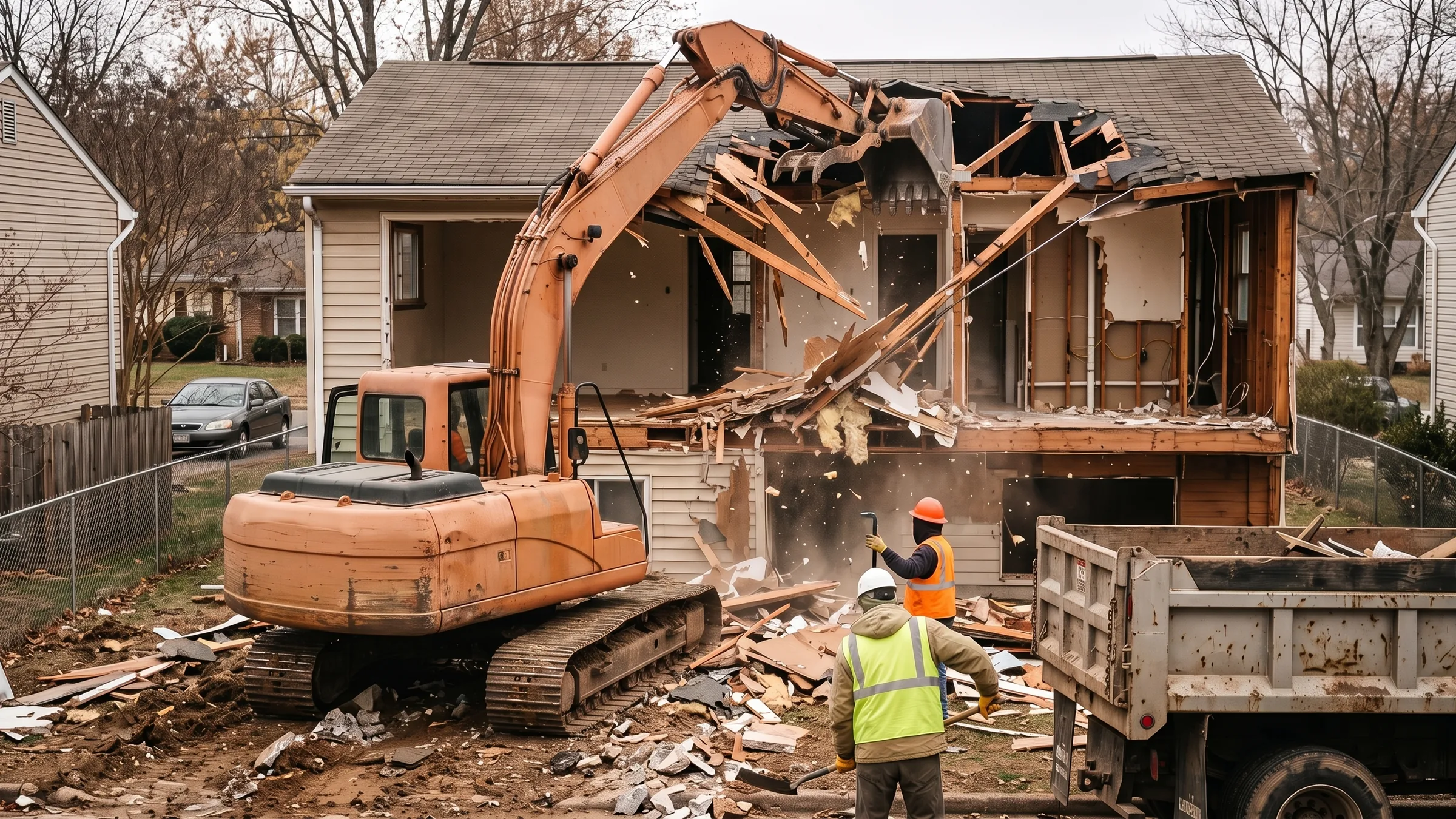
On teardown day the crew drops silt fence and site protection first, then confirms the disconnect tags one more time before a machine moves. A water line or tank runs the whole time to keep dust down, which matters on Dale City streets where houses sit thirty feet apart.
The machine works the structure down in sections rather than dropping it all at once, so material can be sorted as it falls. Metal, brick, and clean wood get separated where it makes sense. Trucks cycle in and out through the day.
Once the structure is down, the foundation comes out, the hole gets backfilled and compacted, and the site is graded to drain away from neighboring lots. Most single-family teardowns take one to three days of machine work plus a day or two of hauling.
What does the finished lot look like?
A finished residential demolition leaves a level, clean pad with no exposed rebar or block, a signed final county inspection, and disposal tickets in your hand. The house being down is not the finish line. That paperwork is.
If a builder is coming behind the teardown, the grade gets set to what the plan calls for instead of guessing. If the lot is going on the market, a seeded, drained surface shows far better than bare clay.
If the structure is fine and the problem is a cracked driveway or an old patio slab, look at breaking out and hauling the concrete instead. That is a one-day job at a fraction of the cost.
We handle house teardowns for property owners around Woodbridge and for older lots down in Dumfries, where Route 1 redevelopment keeps turning over aging houses.
Residential demolition questions we hear in Dale City
How long does a house demolition take from first call to finished lot?
Plan on three to six weeks for a house teardown in Prince William County. Most of that window is permit review and utility disconnects, which run on the county and utility schedule rather than the contractor schedule. The teardown itself is usually one to three days of machine work, plus a day or two of hauling and grading. If you have a closing date or a builder waiting, start the paperwork six weeks out.
Do I have to be there while the house comes down?
No. You do not need to stand on the lot while a house is demolished. You do need to be reachable, and you should walk the site with the contractor before work starts so property pins, trees, fences, and anything you want protected are marked. After that walk the job runs without you. Owners who live out of state handle these teardowns by phone and photos routinely.
What happens to the foundation and the basement hole?
On a standard house teardown in Dale City the foundation walls, footings, and slab come out with the structure unless you ask otherwise. The hole is then backfilled with clean fill, compacted in lifts of about a foot, and rough graded so water drains away from neighboring lots. Leaving a foundation buried costs less today, but it limits what can be built there later and it becomes something you have to disclose when you sell.
Can I keep parts of the house, like the brick or the appliances?
Often yes, as long as you say so before the bid rather than after. Appliances, fixtures, cabinets, and reclaimable brick can be pulled out ahead of the machines on most Prince William County teardowns. Salvage adds labor hours and slows the schedule slightly, so it changes the price, but it also cuts disposal tonnage and keeps usable material out of the landfill.
Who pays for the asbestos inspection?
The property owner pays for the asbestos survey, though the demolition contractor usually schedules it and folds the cost into the estimate. A survey on a typical Dale City house runs a few hundred dollars. If it comes back clean, the teardown moves forward on schedule. If it finds regulated material, licensed abatement has to finish before any structure comes down, which commonly adds a few thousand dollars and a week or two to the timeline.
Will my neighbors get any warning?
Neighbors are not formally notified before a house teardown, so a knock or a note a few days ahead is worth the effort. That matters most on the narrow streets common in older Dale City sections, where trucks and trailers have to stage along the curb. Dust control, silt fence, and keeping every machine inside your property lines are what keep the street on your side once work starts.
Get a real number for your teardown
Every teardown starts with one conversation. Call and describe the structure, the lot, and when you need it gone, and you will get an honest range plus a clear list of what the permit and inspection process looks like for your address.
Prefer to type it out? Use the form below and you will get a call back with the same information.