
We provide garage demolition in Dale City, VA along with shed and deck removal across Prince William County for homeowners with a failing outbuilding. The structure comes down, all the debris leaves your property, and you get a raked, level site back.
This page answers one question. Is this garage, shed, or deck worth saving, and what happens if it comes down?
Small structure teardowns are the quickest work in this trade. Most detached buildings come down, load out, and disappear inside a single working day, which is why the yard looks twice as big by dinnertime.
What does garage demolition and small structure removal cover?
Garage demolition and small structure removal in Dale City covers any detached or attached accessory building on a residential lot, plus the concrete under it when you want that gone too. The usual list:
- Detached one-car and two-car garages
- Attached garages, where the house wall gets closed back in
- Carports, lean-tos, and metal frame shelters
- Wood, vinyl, and metal storage sheds
- Decks, stairs, landings, and railings
- Screened porches, sunrooms, and three-season rooms
- Pergolas, gazebos, arbors, and old playsets
- Small barns, workshops, and hobby buildings
- The slab, footings, and pier blocks underneath, when you want them gone
Every one of those jobs includes the teardown, full debris removal, and a raked, level site. Nothing gets left in a pile for you to deal with on Saturday.
How do you know a garage, shed, or deck is done?
A garage, shed, or deck is done once the frame itself is the problem rather than the surfaces on it. These structures fail from the bottom up and from the fasteners out, so once the posts, sill, or ledger go, cosmetic repairs are money spent on a structural problem.
- Posts soft at ground level, or a sill plate you can push a screwdriver into
- A roofline that sags, waves, or has pulled away from a wall
- Doors and windows that no longer sit square in their openings
- Termite or carpenter ant damage through framing
- Rust-stained, loose, or missing fasteners at a deck ledger
- Deck boards that flex underfoot or joists with visible rot
- A slab that has heaved or cracked and taken the walls with it
Deck ledger connections are the single most common failure point in residential deck collapses, and decks built before modern flashing and fastener requirements are the ones most likely to let go under a full crowd.
If your deck is original to a 1970s or 1980s house and has never been rebuilt, an honest inspection is worth more than another coat of stain.
Why do garages, sheds, and decks fail so predictably?
Garages, sheds, and decks fail predictably because they sit close to the ground, catch weather on every side, and were usually built lighter than the house they serve. The same causes turn up on Prince William County properties over and over.
- Rot at grade: posts, sill plates, and stair stringers that touch soil or sit on a wet slab wick moisture and go soft from the inside
- Water intrusion: a failed roof or a missing ledger flashing lets water run behind the siding for years before anything shows on the surface
- Freeze and thaw: shallow footings and pier blocks lift and drop each winter, which racks the frame out of square a little more each season
- Base failure under the slab: soil washes out from beneath a garage floor, the slab cracks, and the walls sitting on it move with it
- Fastener corrosion: nails and bolts rust where water sits, and a ledger with rusted fasteners can hold weight right up until the day it does not
- Insects: termites and carpenter ants follow moisture into the same wet framing
That is everyday reality across the older Dale City subdivisions, where the first generation of detached garages, decks, and backyard sheds all went up within a few years of each other and are now aging out together.
Should you repair the structure or tear it down?
Repair a garage, shed, or deck when the frame is sound and the damage is limited to surfaces, and tear it down when the framing, footings, or slab have gone. On a small outbuilding the crossover point comes fast, because rebuilding costs are close to repair costs.
Repair is usually the better call when:
- Only decking boards, siding panels, shingles, or a garage door need replacing
- Posts and beams are solid and the structure still sits square
- The slab is level and uncracked, or cracked only at the surface
Demolition is usually the better call when:
- Framing, sill plates, or ledger boards are rotted, and repair means rebuilding most of the structure anyway
- The building sits in the wrong place for the addition, driveway, or pool you want next
- Repair estimates land above roughly half the cost of building new
- The structure is unpermitted, undersized, or does not meet current setback rules, so any repair invites a code conversation
Old detached garages are the clearest case. A structure that was framed for a 1965 sedan often will not hold a modern vehicle, so spending thousands to save it buys you a building you still cannot use.
Do you need a permit for garage demolition in Prince William County?
For garage demolition in Prince William County, almost always yes. Removing a permanent accessory structure is permitted work through Prince William County Development Services, because the county keeps a record of what stands on your lot.
Small sheds that never needed a building permit to install often do not need one to remove, but confirm that rather than assume it.
You can start with the county's Development Services office, which handles permits for Dale City, Woodbridge, Lake Ridge, and the rest of unincorporated Prince William County.
Age is what triggers the testing requirement on an outbuilding.
Older garages and sheds in this county often have cement-board siding panels, roofing felt, or floor tile that can contain asbestos.
Virginia requires an asbestos inspection before demolition of many older structures, and the federal NESHAP rule controls how any regulated material is removed and disposed of. A survey on a small building is inexpensive and it keeps the whole job legal.
Utilities come next. Detached garages very often have a buried electrical feed from the house panel, and sometimes a water line for a hose bib. Those get killed at the source and verified dead before the walls come down.
While you are checking credentials, you can look up any Virginia contractor's standing through the Virginia DPOR contractor board.
What does garage demolition cost in Dale City, VA?
Garage demolition in Dale City, VA is priced on size, materials, access, and whether the concrete goes with the structure. Typical Northern Virginia ranges:
- Storage shed removal: roughly $500 to $2,000
- One-car detached garage: roughly $2,500 to $6,000
- Two-car detached garage: roughly $4,000 to $9,000
- Standard wood deck: roughly $1,000 to $3,500
- Large or multi-level deck with stairs: roughly $3,000 to $6,000
- Slab or footing removal, added to any of the above: often $1,000 to $3,000
Asbestos findings and tight backyard access are the two things most likely to push a small teardown out of its normal range, since either one can turn a machine job into a hand job. Debris weight matters too.
Masonry garages generate several times the tonnage of a frame structure, and disposal at the county complex out at Independent Hill or a private construction and demolition facility is billed by the ton. Ranges for every other job type are in the Prince William County demolition cost guide.
What happens on teardown day?
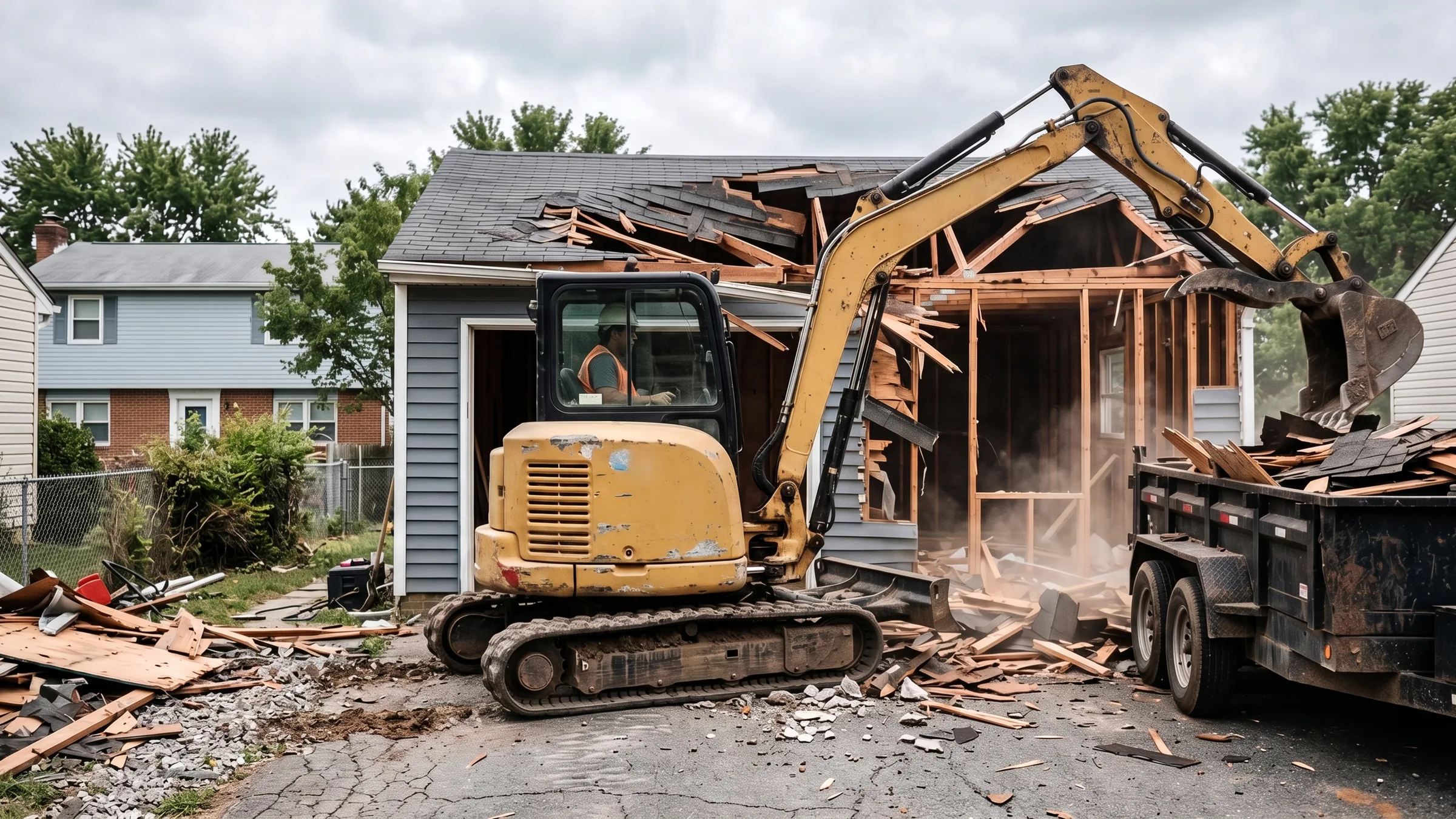
Teardown day on a small structure is short and loud. The crew protects the drive path, confirms the disconnects, and checks clearances to fences, trees, and the neighbor's property line before anything moves.
On tight Dale City lots the machine often works from the driveway with the trailer staged in the street. Structures come down in sections so material can be sorted as it falls.
Metal roofing and framing go to scrap, clean wood and shingles head to disposal, and the site gets swept for nails before anyone calls it done. That nail sweep matters more than it sounds if you have kids, dogs, or bare feet in that yard.
The last hour is cleanup: slab out if that was the scope, footings pulled, the ground backfilled and raked flat, and the area ready for grass, gravel, or the new structure you have been picturing.
Work that pairs with a small structure teardown
If the slab is staying behind but cracked and settled, taking the concrete out is a separate and much simpler job. If the outbuilding is failing because the whole property is due for a reset, look at a full house and site teardown instead.
We do the same small-structure work for owners in Woodbridge and across the City of Manassas, where permits come from the city office rather than the county.
Garage demolition questions from Dale City homeowners
How fast can a detached garage come down?
The teardown itself is usually a single day for a detached garage, and small sheds and decks are often a half day. The slower part sits at the front of the job: pulling the permit through Prince William County and getting the power feed to the structure killed and confirmed dead at the panel. Plan on one to three weeks from first call to demolition day, with the teardown itself being the short part.
Do I need to empty the garage or shed first?
Yes for anything you want to keep, and always for paint, fuel, propane, batteries, pesticides, and pool chemicals, none of which can go in a demolition load. General junk and old furniture can usually be included for an added disposal charge if you tell the estimator up front. Sorting the contents yourself before demolition day is the single easiest way to keep the price at the low end of the range.
Does the concrete slab come out too?
Only if you ask for it. Some owners keep the slab under a torn-down garage for a shed, a basketball pad, a future build, or extra parking. Removing it adds tonnage and truck trips, so it is quoted as a separate line rather than assumed either way. If the slab is cracked, heaved, or sitting where a new foundation needs to go, take it out while the equipment is already on site.
What about the deck footings attached to my house?
Ledger boards get cut free from the house and the fasteners pulled, then the siding or sheathing gets patched enough to keep weather out until you side or rebuild. Concrete pier footings can be dug out entirely or cut off below grade, depending on what goes in that spot next. Tell the estimator whether a new deck or a patio is coming, because that decides which of the two is worth paying for.
My shed has old corrugated siding. Is that a problem?
It might be. Corrugated cement-board panels and some old roofing from that era can contain asbestos, so those materials get tested rather than ripped down. A survey on a small outbuilding is inexpensive next to the cost of an uncontrolled release. If a test comes back positive, licensed abatement happens before the structure comes down, which typically adds a week and a few hundred to a few thousand dollars.
Clear the backyard and be done with it
A small structure teardown is the fastest job on this site to schedule. Send a photo, rough dimensions, and whether the slab should go, and you will get a straight price range without a site visit in most cases.
Call now, or drop the details in the form below and you will get a call back with a number and a date.