
Common Questions About Demolition Permits and Costs in Prince William County
This page answers the demolition permits and cost questions Prince William County homeowners, landlords, and builders ask most: county permits, Virginia asbestos rules, utility disconnects, debris disposal, and honest price ranges. Use it to set a realistic date and budget.
What does it actually take to get a structure torn down in Virginia? Most people asking that question have never hired a demolition crew before, and the answers are hard to find in one place.
So here they are, written out the same way we would explain them standing in your driveway.
Nothing here is legal advice, and county rules change, so confirm anything that affects your schedule before you commit to a date.
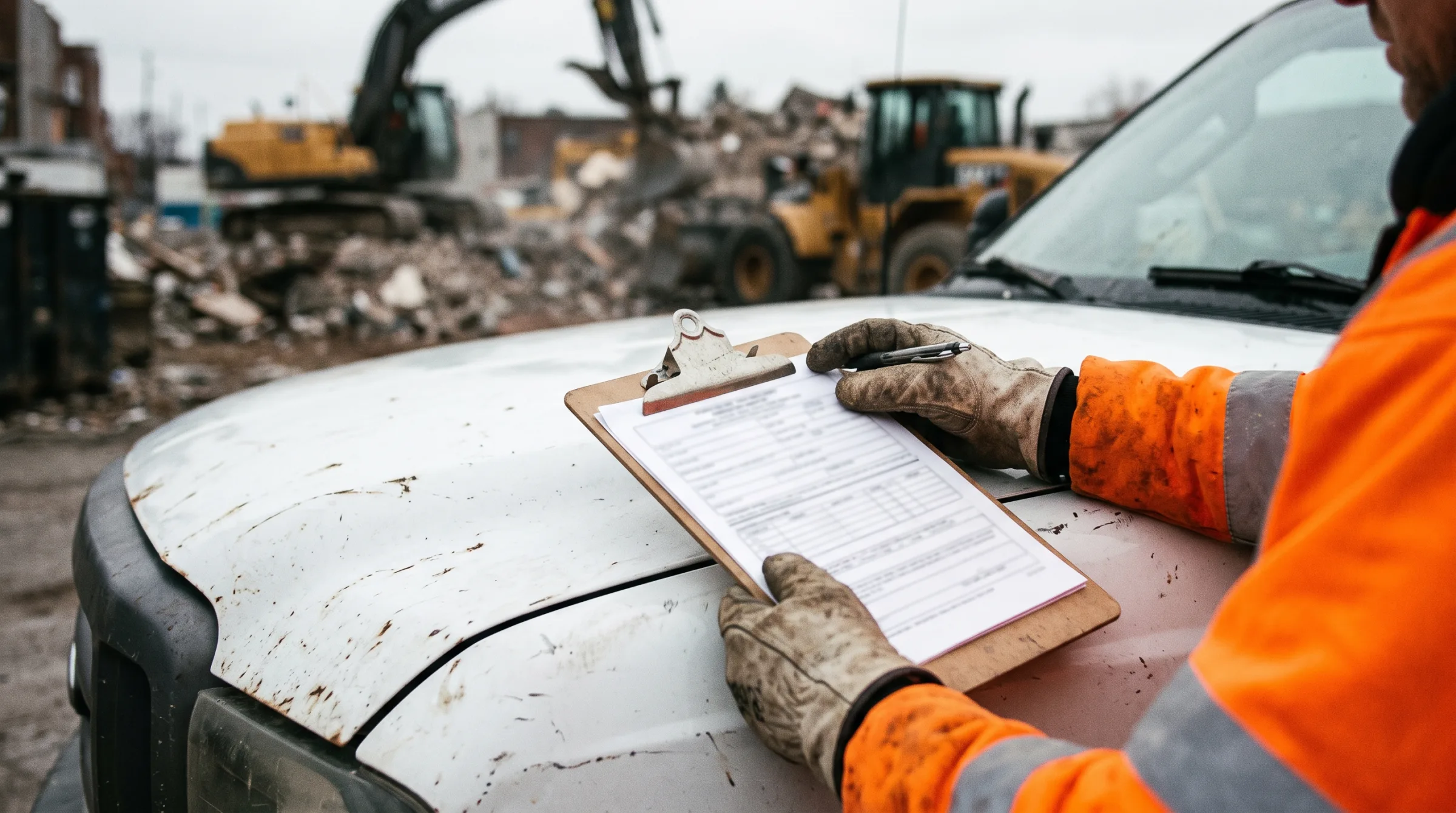
Demolition Permits and Cost Questions for Prince William County Property Owners
The twenty answers below are ordered so the permit and asbestos questions come first, because those set your start date. Cost questions follow, with real ranges instead of a fixed number that no demolition contractor could honor sight unseen.
Each answer stands on its own, so you can jump straight to the one you came for.
When does Prince William County require a demolition permit?
Prince William County requires a demolition permit almost any time a structure comes down. The county's Development Services office issues those permits for houses, detached garages, larger sheds, decks, in-ground pools, and commercial buildings.
Plan on a permit for any full structure teardown, and expect the county to want proof that the utilities are disconnected before it issues one. Confirm the current requirements at pwcva.gov before you set a date.
Do I need an asbestos inspection before demolition in Virginia?
Virginia requires an asbestos inspection before demolition on most older buildings. State rules and the federal EPA NESHAP program call for a licensed inspector to survey the structure for asbestos containing materials first.
Buildings put up in the 1970s or earlier carry the highest risk, especially floor tile, pipe wrap, siding, and roofing. The survey usually costs a few hundred dollars and takes a day or two to schedule, so book it early.
What happens if an asbestos survey finds asbestos before demolition?
If an asbestos survey finds asbestos containing material, a licensed abatement contractor removes it under containment before any demolition starts. That step is not optional, and it adds cost plus a week or two to the schedule.
A little pipe wrap stays cheap. Whole-house siding or flooring costs real money. Clearance paperwork is issued once abatement passes, and the demolition crew works after that.
Who confirms the utility disconnects before a teardown?
Before Prince William County approves a teardown, electric, gas, water, sewer, and sometimes cable all need a documented disconnect or cap. You or your demolition contractor calls each utility, and the county wants written confirmation.
Gas and electric push demolition dates back more often than anything else, so start those requests two to three weeks ahead. Call Virginia 811 for underground line marking before anyone digs.
Where does construction and demolition debris go in Prince William County?
Clean construction and demolition debris from Prince William County jobs goes either to the county landfill complex at Independent Hill or to a private recycling facility that takes those loads. Concrete, brick, and block are often crushed and reused.
Wood, drywall, and mixed loads cost more per ton. Disposal is usually one of the two or three largest line items in a demolition price, which is why debris tonnage drives the number more than square footage does.
How much does it cost to tear down a house in Northern Virginia?
Most full residential teardowns in Northern Virginia land between roughly $12,000 and $30,000, and large, brick, or hard-access houses go past $40,000. Square footage, foundation type, asbestos findings, equipment access, and disposal tonnage move the number the most.
No honest demolition contractor can price a teardown without standing on the site. A firm number over the phone is a guess. Collect two or three written quotes and compare what each one includes for permits, disposal, and grading. Our house teardown cost guide breaks the ranges down by house type.
What does a garage, shed, or deck demolition usually cost?
Detached garages, sheds, and decks are the least expensive demolition work there is in Prince William County. A deck or a shed commonly falls between about $1,000 and $3,500, including haul-off.
A detached garage with a slab often runs $3,500 to $9,000, because the concrete adds weight and dump fees. Tight backyard access surprises people most, since a machine that cannot reach the structure turns the job into hand work.
How much does concrete removal cost per square foot?
Concrete removal around Prince William County is usually priced by area and thickness, commonly $2 to $4 per square foot for unreinforced flatwork and $4 to $8 for reinforced or thicker slabs, removed and hauled.
Difficult access can push past those ranges, because concrete a truck cannot reach gets carried out by hand. Hauling is the hidden cost either way, since a two-car driveway can weigh twenty tons or more once it is broken out.
How long does a demolition project take?
Plan on two to six weeks from your first call to demo day on a permitted demolition in Prince William County. The machine work is the fast part: a deck comes down in hours, a garage in a day, and most houses in one to three days.
Paperwork is the slow part, because the permit, the asbestos survey, and the utility disconnects all have to clear first. Work that needs no permit can often start within a few days.
What do homeowners handle, and what does the demolition contractor handle?
On a typical Prince William County demolition, the property owner decides what stays, clears out personal property, and signs the permit application as the owner of record.
The demolition contractor files the permit, coordinates the asbestos survey, schedules utility disconnects, runs the equipment, hauls the debris, backfills, and grades. Ask any contractor to put that split in writing before work starts.
How do I verify that a demolition contractor is licensed in Virginia?
Search the company name in the Virginia Department of Professional and Occupational Regulation license lookup at dpor.virginia.gov. Check the license class, the status, and the expiration date.
Make sure the licensed name matches the business writing your contract, and run this check on every bid you collect, including ours. An expired license or the wrong class is a real problem on permitted demolition work.
What insurance questions should I ask a demolition contractor?
Ask any demolition contractor for a current certificate of insurance sent straight from the agent rather than a copy handed to you. Confirm the general liability limits, workers compensation for the crew, and that your job address appears on the certificate.
Then ask a direct question: who pays if a machine clips a neighbor's fence or a utility line? Get that answer in writing before demolition starts, because uninsured damage becomes your problem fast.
Should I remove my in-ground pool completely or fill it in?
Both are legitimate ways to get rid of an in-ground pool. A partial removal breaks up the deck, punches the bottom for drainage, drops the walls in, and fills the void with engineered fill. A full removal takes out every piece of shell and steel.
Partial removal works when you want the yard back for lawn or patio at the lowest cost. Full removal is better when you may build over that footprint or sell soon. The pool removal page covers the tradeoffs.
Do I have to tell a buyer about a filled-in pool?
Virginia's residential disclosure law puts much of the investigation burden on buyers, but buyers, home inspectors, and sometimes lenders ask about a filled-in pool anyway.
Keep the demolition permit, the fill material receipts, the compaction records, and the final inspection paperwork in one folder. Good documentation turns an uncomfortable question into a short answer and protects the value of the work you paid for.
How loud and dusty is a demolition day?
A demolition day is loud for a short window and dusty only if nobody manages it. Equipment runs roughly in the 85 to 100 decibel range at the property line, and only while the machine is actually working.
A good crew wets the work down with a hose or water trailer, protects the surfaces that stay, and sweeps the street at the end of the day. Ask how dust and debris control will be handled before you sign anything.
Do my neighbors need notice before demolition starts?
Prince William County does not require neighbor notice for a typical residential demolition, but give it anyway. A short conversation a week ahead about dates, work hours, and truck parking prevents most complaints.
If you share a driveway, a fence, or a wall, put the notice in writing and photograph the shared areas before work begins. Those photos settle later arguments about damage that was already there.
Can you demolish part of a house and leave the rest standing?
Yes. Taking down part of a house and leaving the rest standing is called selective demolition, and it is what most remodels actually need.
The crew cuts back to the framing you want to keep, protects floors and stairs, braces anything structural, and hauls the rest out. Details are on the interior and selective demolition page.
What happens to the hole after a house comes down?
After a house comes down, the foundation and slab come out, the hole gets backfilled in lifts with clean fill, each lift is compacted, and the lot is graded so water drains away from the neighbors.
If you plan to build on the same footprint, say so before backfill starts. Your engineer may require specific fill material and compaction testing, and redoing a backfill later costs far more than doing it right once.
Is a demolition contractor the same as a wrecking company?
Yes, for the work homeowners need. A wrecking company, a demolition contractor, and a tear down contractor all describe the same trade: taking structures down and hauling the debris away. The older term wrecking survives mostly in company names and in commercial building demolition.
Whatever the name on the truck, what matters in Prince William County is the same list: a current Virginia contractor license, insurance, the demolition permit, and a written scope that includes disposal and grading.
Is demolition the same thing as junk removal?
No. Junk removal crews carry contents out of a building. Demolition crews take the building apart, handle permits and Virginia asbestos rules, run machines, and haul debris away by the ton.
Some junk haulers do light demo on the side, which is fine for a closet or a countertop. For anything structural, permitted, or built before 1980, hire a demolition contractor.
What do you need from me to quote a demolition job?
To quote a demolition job in Prince William County we need the property address, what needs to come down, rough dimensions, the year the structure was built, and photos if you have them.
Access matters just as much, so mention gates, slopes, overhead wires, and how close the neighbors sit. Call and you can usually get a range on the phone, then a written number after a site visit.
Still Have a Demolition Question About Your Property?
Call if your demolition question is not answered above. The list covers the permit and cost questions Prince William County owners ask most, but it will never cover yours exactly.
Every lot is different, and the odd ones are the fun ones: a pool under a deck, a garage sharing a wall with the neighbor, a slab nobody knew was eighteen inches thick.
Call and describe it. If the job is not a fit, we will say so and point you at whoever handles that work.
You can also read what the work looks like on a full house teardown, an in-ground pool fill-in, or a lot that needs clearing before construction, and see the towns we cover on the service areas page.
Get Your Demolition Question Answered Today
Tell us what needs to come down and where it sits. You get a straight answer on scope, timeline, and price range.
Call 703-936-7801Serving Dale City and all of Prince William County, Virginia.